A school can put radios in the hands of administrators, custodians, maintenance staff and transportation personnel and still have a communication problem.
The radio itself is only one part of the system.
Frequency, building construction, antennas, repeater coverage, programming and the way radios are actually used all affect whether someone can communicate when they need to. A system that works perfectly in the front office may behave very differently in a mechanical room, at an athletic field or several miles away on a bus route.
For schools, that matters every day.
A student gets injured on the playground. Maintenance needs to be reached about a problem in another part of the building. A bus is delayed on its route. Staff are coordinating dismissal. An administrator is outside during an event while other personnel are inside the building.
None of those situations are unusual, but all of them become easier to manage when the people involved can communicate quickly and reliably.
So what actually makes a school radio system reliable?
Coverage Is More Than the Range Printed on a Radio Box
One of the easiest mistakes to make with two-way radios is treating range as a fixed number.
In the real world, radio coverage depends heavily on the environment.
A portable radio being used across an open property is operating in a much different RF environment than the same radio being used from inside a mechanical room to someone on the opposite side of a school.
Concrete, steel, below-grade spaces and other parts of a building can attenuate or redirect radio signals. Building additions can also create coverage problems that weren’t present when the original radio system was installed.
That is why simply moving to a higher-powered radio isn’t always the answer.
Transmit power is one part of the coverage equation, but frequency, antenna performance and placement, building construction, terrain, receiver performance and system infrastructure all play a role.
The better question isn’t, “How many miles does this radio reach?” It’s “Does this system provide usable coverage everywhere our people need it?”
For a school, that may include classrooms, offices, hallways, stairwells, mechanical areas, cafeterias, athletic facilities, parking lots, maintenance buildings and transportation facilities.
Direct Radio-to-Radio Communication vs. a Repeater
Not every school radio system is built the same way.
In a basic setup, portable radios may communicate directly with one another. This is often called simplex or talk-around operation.
That can work well when users are relatively close together and the environment allows a usable signal to travel between them.
Larger buildings and campuses may require something different.
A repeater receives a transmission and retransmits it from another location, typically with an antenna positioned to provide better coverage than a portable radio could achieve on its own.
Imagine two employees standing on opposite ends of a large school. In direct operation, the signal from one portable has to make the entire trip to the other portable. With a properly designed repeater system, each portable instead needs to communicate reliably with the repeater.
Repeaters can also be part of larger system designs. Depending on the technology and configuration, multiple sites can be connected to extend communications across larger properties or separate locations.
The right design depends on what the school is trying to cover. Adding infrastructure without first understanding the coverage problem can be just as ineffective as replacing radios without understanding why the old ones weren’t working.
VHF or UHF? It Depends on the School
Schools sometimes inherit a radio system that has been in place for years without anyone asking why it operates on a particular frequency band.
Commercial land-mobile radio systems commonly operate in VHF or UHF spectrum, and each has characteristics that can influence system design.
There isn’t a universal rule that every school should use one or the other.
A district with a large geographic footprint and substantial outdoor operations presents a different RF problem from a compact school primarily concerned with coverage through a large building. Existing infrastructure, licensed frequencies, interference, antenna systems and the district’s coverage requirements all need to be considered.
This is also why changing frequency bands isn’t something that should be treated like changing a setting on the radio. Commercial radio systems operate under FCC licensing requirements, and frequency planning and coordination need to be part of the system design.
Digital Doesn’t Automatically Fix Bad Coverage
Moving from analog to digital can bring significant advantages, but digital shouldn’t be treated as a cure for every radio problem.
Digital systems can support features and capabilities that aren’t available on a basic analog system. Depending on the technology and equipment, that can include unit identification, individual and group calling, data functions, improved channel efficiency and additional signaling or security capabilities.
DMR Tier II uses two time slots within a 12.5 kHz channel, allowing two communication paths to use that channel. NXDN can operate using 6.25 kHz FDMA channels, along with other configurations depending on the system. Those differences can become important as the number of users and amount of radio traffic increase.
But digital technology still has to obey the laws of RF.
If a building has a significant coverage problem, changing a fleet from analog to digital doesn’t automatically make the obstruction disappear. Coverage and system design still matter.
Programming Matters More as a Radio Fleet Grows
A school with eight radios has different communication needs from a district with dozens or hundreds of radios spread across multiple departments.
As the fleet grows, programming becomes increasingly important.
Administration may need to communicate frequently with office staff. Maintenance and custodial employees may have their own routine conversations. Transportation may generate significant radio traffic that doesn’t need to be heard by every employee inside the school.
That doesn’t necessarily mean those groups should be completely isolated from one another.
It means the system should be programmed around how the organization actually communicates.
Channels or talkgroups, zones, scan lists and other programming options can help organize radio traffic so users hear the conversations they need without listening to every transmission made across the district.
The goal isn’t to create the largest possible channel list. It’s to make the radio simple enough that someone can pick it up and know where they need to be.
A technically impressive system isn’t very useful if everyday users find it confusing.
Radio Features Should Have a Purpose
Modern commercial radios can support far more than basic push-to-talk voice communication.
Depending on the radio and system, available capabilities may include emergency buttons, GPS/location functionality, individual calling, group calling, text or status messaging, encryption and other signaling features.
That doesn’t mean every school needs every available feature.
An emergency button, for example, is only useful if the system is configured so the activation goes somewhere meaningful and staff understand what happens after it is pressed.
The same applies to encryption. Digital radio and encrypted radio are not the same thing. If a school determines certain communications should be protected, encryption has to be deliberately selected and configured.
Good radio design starts with the school’s workflow and works backward to the equipment.
Reliability Can Come Down to the Small Things
Some radio problems have nothing to do with towers, frequencies or repeaters.
A weak battery can shorten operating time. A damaged antenna can affect performance. Poorly chosen accessories can make audio difficult to hear. A radio carried underneath clothing or in an unusual position may perform differently than expected.
Charging is another basic consideration that becomes increasingly important as fleets grow.
If radios are expected to be available throughout the school day, the district needs a practical process for charging, assigning and maintaining them. Transportation departments and second-shift maintenance or custodial teams may have very different schedules from school administrators.
These aren’t exciting parts of a radio system, but they’re often the difference between equipment that looks good on a specification sheet and equipment that works well every day.
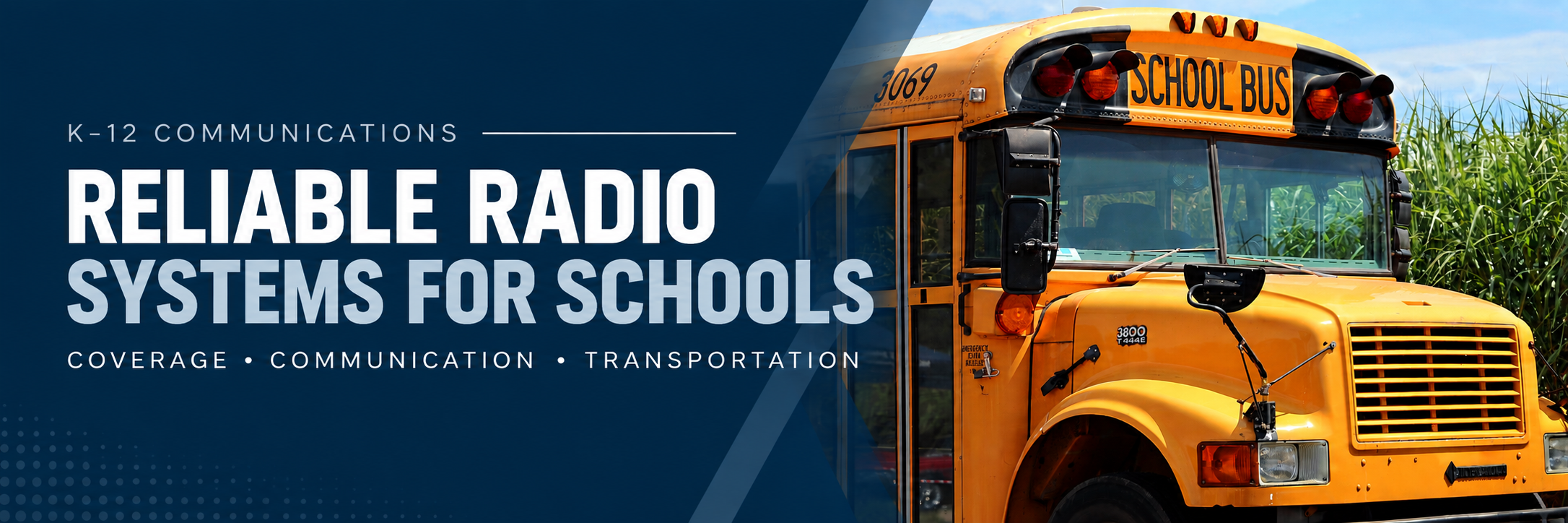
School Transportation Changes the Coverage Problem
Once a bus leaves school property, the communication problem changes.
Inside a building, system designers are primarily concerned with getting RF signals through and around the structure. Transportation adds distance, changing terrain, vehicles and a much larger geographic area.
It also introduces another equipment decision: portable or mobile radio?
A portable radio is convenient because it can leave the vehicle with the user. A properly installed mobile radio, however, can operate with a vehicle-mounted external antenna positioned outside the bus rather than relying on a portable antenna being used inside a large vehicle.
That difference can matter when trying to communicate over longer distances.
The system behind the radio matters too. A repeater that provides excellent coverage throughout a school and its surrounding property doesn’t automatically provide reliable communication everywhere buses travel.
Actual routes need to be considered.
Rural roads, terrain, distance from the repeater and other RF conditions can create areas where coverage changes significantly.
For transportation departments, the question isn’t simply whether the radio works in the bus garage. It’s whether it works where the buses actually go.
National School Bus Safety Week: October 19–23, 2026
National School Bus Safety Week is an opportunity to recognize the drivers and transportation teams who help students get to and from school safely. It is also a good time for districts to look at the systems supporting their daily operations.
For transportation departments, reliable communication is part of that preparation. When a bus breaks down, a route changes or weather disrupts the afternoon schedule, drivers and dispatchers need a dependable way to reach one another.
That reliability should not be assumed simply because a radio works at the bus garage. Coverage should be evaluated along actual routes, and drivers should know how to contact dispatch when normal communications are unavailable.
School bus safety matters every day of the year. National School Bus Safety Week is a timely reminder to review the communication tools and procedures that help transportation teams do their jobs.
Supporting Indiana School Transportation
J&K Communications is proud to partner with the Indiana School Bus Drivers Association and support the professionals responsible for safely transporting students throughout Indiana. School communications don’t end at the building, and transportation should be considered as part of the district’s overall communication plan.
A Radio System Should Be Tested Where People Actually Work
One of the best ways to understand an existing radio system is also one of the simplest: test it.
Not from one desk. Not only in the hallway. And not just in the parking lot.
Testing should reflect how the radios are actually used.
Can an employee in a mechanical area reliably reach the office? What happens in stairwells? Can staff communicate at athletic facilities? Does coverage extend to maintenance buildings? Are there areas of the property where users regularly have to repeat themselves?
For transportation, where does coverage begin to weaken along actual routes?
Patterns matter.
One isolated bad transmission may have any number of causes. Consistent problems in the same locations point toward something that deserves a closer look.
And the answer isn’t always new radios.
A coverage issue could involve antennas, infrastructure, programming, damaged equipment, system design or the way the existing equipment is being used. Identifying the actual problem before purchasing equipment can save a district from spending money without fixing what caused the problem in the first place.
Do You Know Where Your Radio System Stops Working?
Schools depend on communication during far more than emergencies. Arrival, dismissal, transportation, maintenance, athletics, events and normal day-to-day operations all put different demands on a radio system.
If your district’s understanding of radio coverage is based primarily on where staff have complained—or where someone happened to test a radio—you may not have the complete picture.
J&K Communications can help evaluate an existing school radio system, identify coverage and programming limitations, and determine what actually makes sense for the district. That could mean reprogramming existing equipment, addressing infrastructure, improving coverage, replacing aging equipment or simply making better use of a system that’s already in place.
Before you add more radios, make sure the system behind them is doing its job.
Talk with J&K Communications about your school’s current radio system, campus coverage or transportation communication needs.
Call 260-244-7975 to start a conversation about your school’s communication system.