Public-safety radios are a major investment, especially when an agency is replacing an entire fleet. But comparing radios by price alone does not tell the full story. The better comparison is what each radio can do, what is included in the configuration and how much it costs to equip the number of personnel who actually need radios.
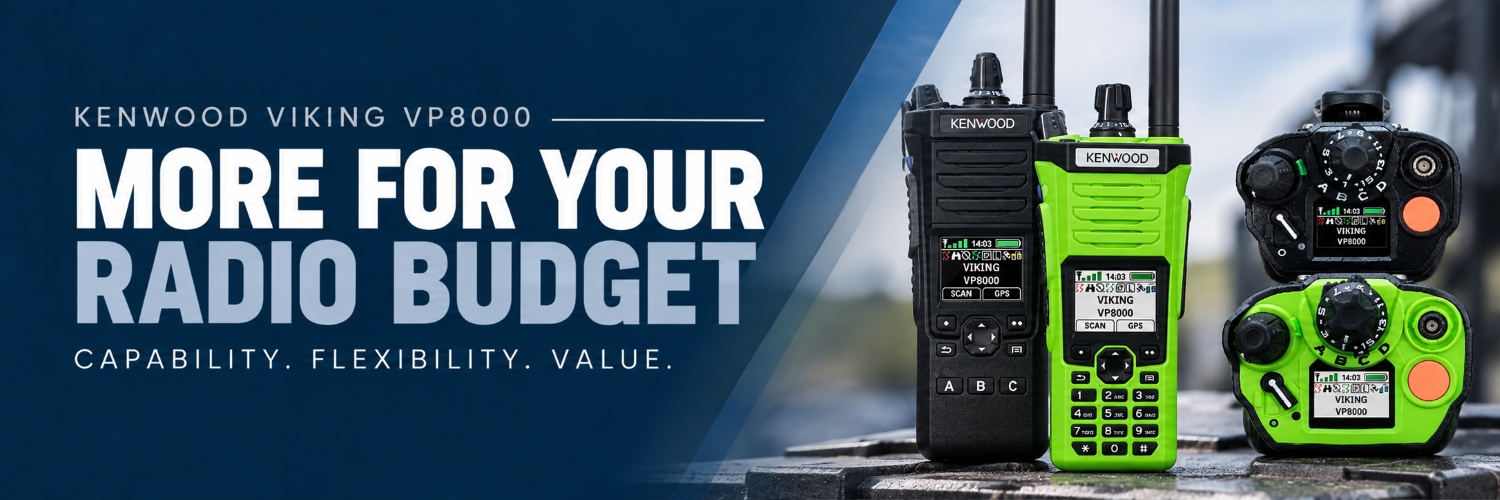
The KENWOOD Viking VP8000 is a multiband, multiprotocol public-safety portable with P25 Phase 1 and Phase 2 capability, VHF, UHF and 700/800 MHz coverage, multiple supported radio protocols, encryption options and other public-safety features.
Those capabilities become particularly important when the price of the VP8000 is compared with other multiband public-safety portable configurations.
The takeaway: Affordability does not mean much if a radio cannot meet an agency’s technical requirements. The VP8000 combines multiband coverage, P25 Phase 1 and Phase 2, multiple additional protocols, encryption options and other public-safety capabilities in one platform. Once the technical requirements are met, the difference in total fleet cost can become significant.
What Does the Viking VP8000 Actually Support?
The VP8000 is not limited to one frequency band or one digital radio format. It covers VHF, UHF and 700/800 MHz and supports multiple communications protocols within the same portable platform.
| Capability | Viking VP8000 |
|---|---|
| P25 Phase 1 Trunking | Supported |
| P25 Phase 2 Trunking | Supported |
| P25 Conventional | Supported |
| DMR Tier II | Supported |
| DMR Tier III | Supported |
| NXDN Conventional | Supported |
| NXDN Type-C Trunking | Supported |
| Viking16 SmartNet/SmartZone-Compatible Operation | Supported |
| Analog FM | Supported |
| Frequency Coverage | VHF, UHF and 700/800 MHz |
| Mixed-Protocol Zones | Supported |
Not every agency needs every protocol listed above. A department operating entirely on P25 may have little reason to use DMR or NXDN. But that does not make those capabilities irrelevant when comparing what is included in the platform.
Agencies may communicate with neighboring departments, utilities, schools, hospitals, emergency-management organizations or other partners operating different radio systems. For those users, supporting multiple protocols and frequency bands from one portable can provide additional flexibility.
The VP8000 also supports mixed-protocol zones, allowing channels from different supported systems to be programmed within the same zone.
P25 Phase 1 and Phase 2 in the Same Radio
For public-safety agencies purchasing radios they expect to keep for years, P25 capability is an important part of the evaluation.
The VP8000 supports both P25 Phase 1 and P25 Phase 2 trunking. P25 Phase 1 uses FDMA and provides one voice path within a 12.5 kHz channel. P25 Phase 2 uses two-slot TDMA for trunked voice traffic, providing two voice paths within the same 12.5 kHz physical channel.
| Feature | P25 Phase 1 | P25 Phase 2 |
|---|---|---|
| Access Method | FDMA | Two-slot TDMA for trunked voice traffic |
| Physical Channel | 12.5 kHz | 12.5 kHz |
| Voice Paths | One per 12.5 kHz traffic channel | Two per 12.5 kHz traffic channel |
| VP8000 Support | Yes | Yes |
The value of supporting both technologies is straightforward: an agency can configure the VP8000 around its current P25 requirements while also having a portable platform capable of P25 Phase 2 operation when required by the applicable system.
This does not mean every agency needs Phase 2 operation today. It means agencies purchasing radios with a multi-year service life can include Phase 2 capability in the equipment they are already buying.
Multiband and Multiprotocol Capability
Frequency coverage is another part of the cost comparison.
A single VP8000 can cover VHF, UHF and 700/800 MHz. For an agency operating entirely within one band, that capability may not be essential. For agencies working across systems, jurisdictions or frequency bands, multiband operation can reduce the limitations of carrying a portable designed around only one band.
The same principle applies to protocol support. P25, DMR, NXDN and analog systems continue to be used by different organizations and applications.
The VP8000’s multiprotocol architecture allows the radio to be configured around the communications environments its users actually encounter.
Why does that matter when discussing price?
A lower price is only meaningful if the radio provides the required functionality. When comparing the VP8000 with another public-safety portable, frequency coverage, protocols, software features, encryption and system requirements should be established before comparing the final price.
Encryption and Security Capabilities
Encryption requirements can have a major effect on a public-safety radio configuration. The VP8000 supports several encryption and security capabilities, including:
- AES-256 encryption
- DES-OFB
- ARC4 software encryption compatible with Motorola ADP
- Single- and multi-key operation
- Over-the-Air Rekeying (OTAR)
- P25 Authentication
An optional FIPS 140-3 Level 3 encryption module is also available.
The exact encryption requirements will vary by agency and radio system. That is why encryption should be compared at the configuration level rather than assuming two base radio models include identical security functionality.
What Else Is Available on the VP8000?
The VP8000 also includes or supports a number of features that may be relevant when configuring a public-safety portable:
- Built-in GPS
- Bluetooth and Bluetooth Low Energy
- Dual-band 2.4 and 5 GHz Wi-Fi
- Man Down
- Instant Recording Replay
- Voice recording
- Text messaging
- Radio cloning
- FIRESafe functionality
- Up to 3-watt audio output
- IP67/IP68 protection
- MIL-STD-810 C/D/E/F/G/H testing
These specifications are important when evaluating affordability because purchase price should not be considered separately from capability.
An agency should first establish what the radio needs to do. Once those requirements are established, the cost of the complete configurations can be compared.
Where the Price Difference Becomes Significant
A difference in the price of one portable may not seem significant when viewed by itself. Across an entire fleet, the same difference can become much larger.
For example, a $1,000 difference per radio becomes $100,000 on a 100-radio purchase. That is before accounting for possible differences in software, accessories, programming or service.
J&K Communications has compared pricing for equivalently configured public-safety portable proposals. Based on our current comparison, the price difference between the Viking VP8000 and a comparable Motorola public-safety portable configuration can approach approximately 2.5 VP8000 radios for the cost of one comparable Motorola radio.
Important: This is not a universal price ratio or guaranteed pricing. Actual pricing depends on configuration, software and feature requirements, encryption, accessories, quantity, available contracts and customer eligibility. The most accurate comparison is between current proposals built around the same operational requirements.
What Can That Difference Look Like Across a Fleet?
Using J&K’s approximate current 2.5-to-1 pricing comparison, the effect becomes easier to see as the number of radios increases.
| Comparable Purchase | Approximate Number of VP8000s for the Same Radio Budget* |
|---|---|
| 10 radios | Approximately 25 VP8000s |
| 20 radios | Approximately 50 VP8000s |
| 40 radios | Approximately 100 VP8000s |
| 100 radios | Approximately 250 VP8000s |
*These examples are based on J&K Communications’ approximate current 2.5-to-1 pricing comparison. Actual pricing and quantities vary based on configuration, software, accessories, contracts, quantity and customer eligibility. These examples are not guaranteed pricing.
What Could an Agency Do With the Difference?
This is where affordability becomes more than a number on a quote.
Public-safety agencies have finite equipment budgets. If two proposed radio configurations both meet an agency’s operational and technical requirements, a substantial difference in acquisition cost can change what that budget is able to accomplish.
Depending on the project, the difference could allow an agency to equip additional personnel, purchase spare radios, add batteries, speaker microphones or chargers, or retain funding for other communications needs.
For a department replacing a large fleet, that changes the question from simply asking what one radio costs.
A better question is: What can our entire radio budget buy?
If the equipment meets the required technical and operational specifications, agencies can compare how many personnel can be equipped and what additional equipment can be included within the same available budget.
Make Sure the Quotes Are Actually Comparable
Radio pricing can become misleading when two proposals contain different equipment, software, licenses, accessories or services.
Two radios may both be described as multiband P25 portables while the actual configurations being quoted are different. That makes it important to compare more than the final number at the bottom of the proposal.
1. What radio hardware is included?
Confirm the model, frequency-band coverage and hardware configuration being quoted.
2. Which software and feature licenses are included?
Determine whether required P25, encryption, system or other functionality is included in the quoted configuration or requires additional licensing.
3. What accessories are included?
Compare batteries, chargers, speaker microphones and any other accessories required to put the radios into service.
4. Are programming and configuration included?
The radio still has to be properly programmed and configured for the systems where it will operate.
5. Is the radio approved for the intended system?
General P25 capability does not automatically mean a radio is authorized for every P25 system. Agencies should verify current system requirements and approved equipment.
6. What happens after the radios are delivered?
Warranty coverage, repair capabilities, future programming, firmware updates and ongoing service should also be part of the comparison.
Compare Capability First, Then Compare Cost
Price should not determine whether a radio meets an agency’s operational requirements. The radio first has to work on the intended system and provide the capabilities the agency needs.
Brand familiarity, existing accessories, infrastructure compatibility, training and fleet-management practices may also have value and should be considered when evaluating a purchase.
Once those requirements are understood, however, total cost deserves the same scrutiny.
The Viking VP8000 combines VHF, UHF and 700/800 MHz coverage, P25 Phase 1 and Phase 2 operation, DMR and NXDN support, encryption and security options, wireless connectivity and ruggedized construction in one portable platform.
For agencies comparing multiband public-safety radios, the question is not simply which radio has the lowest price. It is which configuration meets the required technical and operational needs and what it will cost to equip the fleet.
Compare the Complete Proposal
The most accurate way to evaluate the VP8000’s affordability is to compare actual configurations.
If an agency already has a proposal for another public-safety portable, J&K Communications can build a VP8000 configuration around the same fleet requirements and compare the equipment, features, accessories and total purchase cost.
That gives the agency something much more useful than a generalized radio price: a comparison based on what its personnel and radio system actually require.
Already Have a Radio Quote?
Send J&K Communications the radio model, number of radios needed and any required accessories or system features. We can prepare a Viking VP8000 proposal based on those requirements and show what is included in the complete purchase.
Whether you are replacing a few radios or planning a larger fleet purchase, comparing equivalent configurations can show how far your available radio budget can go.
Compare Your Radio QuoteSources: EFJohnson Viking VP8000 product information and technical documentation; Project 25 technical information; J&K Communications current public-safety portable pricing comparisons. Product features, software, system compatibility and pricing may vary by configuration. Pricing comparisons are approximate and are not guaranteed. Agencies should verify current system requirements, approved subscriber equipment and required features before purchasing.