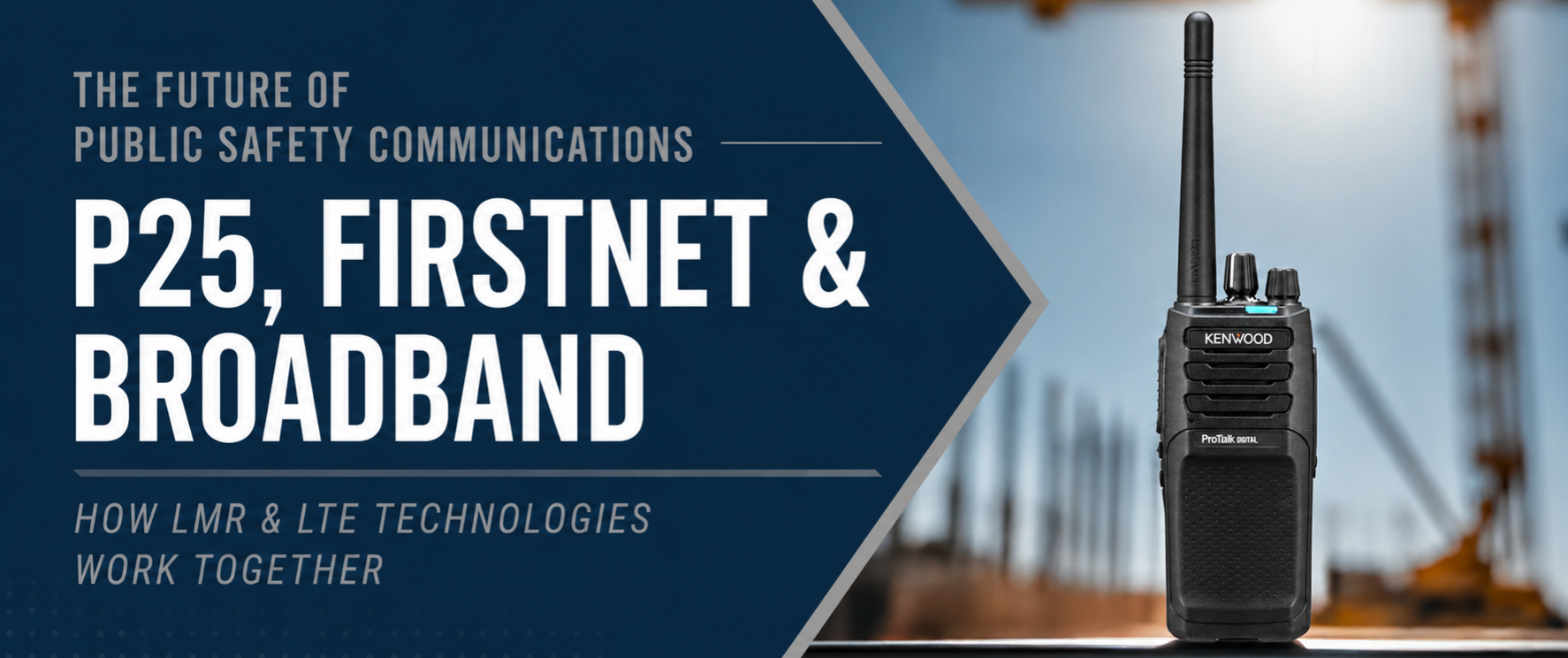
Public safety communications have changed a lot over the last several years. Police, fire, EMS and dispatch personnel still depend on radio for day-to-day voice communications, but a radio is no longer the only communications tool they carry or use.
Mapping, video, mobile applications, location information and other data are now part of the job too. That has put technologies such as P25, FirstNet and public safety broadband alongside one another instead of necessarily putting them in competition.
For agencies planning their next system, that distinction matters. P25 and broadband are built to handle different communications needs, and in many cases an agency may have a reason to use both.
Short Answer
P25 remains a core technology for public safety radio and push-to-talk voice communications. FirstNet and other broadband networks give agencies access to data, applications, mapping, video and connected devices. One does not automatically eliminate the need for the other. The bigger question is how each technology fits the way an agency’s personnel actually work.
Quick Navigation
Why P25 Remains Important in Public Safety Communications
Project 25, or P25, is a set of standards for digital land mobile radio communications. Police departments, fire departments, EMS providers and other government agencies use P25 systems for push-to-talk voice and dispatch communications.
But the portable or mobile radio is only the part of the system the user sees every day.
Behind it can be towers, repeaters, antennas, frequencies, dispatch equipment, network equipment and other infrastructure. All of those pieces have to work together to provide the coverage, capacity and reliability an agency expects from its radio system.
That becomes especially important when you look at where first responders actually work. A county sheriff’s department may need coverage across hundreds of square miles, including rural roads and areas far from a population center. A city fire department may have a smaller geographic footprint but need reliable communications in and around buildings. Those aren’t the same coverage problem.
P25 also gives agencies a standards-based approach to interoperability. Compatible P25 systems and equipment can make it easier for departments and neighboring jurisdictions to communicate when mutual aid is needed.
Where FirstNet and Broadband Fit In
A radio handles an important part of a first responder’s communications, but it isn’t designed to carry every type of information personnel may need.
Think about the amount of information that can be useful before or during a call. An officer may need a map or database information. Fire personnel may need access to building or incident information. Command staff may be working with photographs, video, applications or other data that requires much more bandwidth than a traditional land mobile radio system provides.
That’s where public safety broadband comes in.
FirstNet is a nationwide broadband network built for public safety. It supports smartphones, tablets, vehicle equipment and other connected devices and provides eligible public safety users with features such as priority and preemption.
In practice, that can mean a first responder uses a P25 radio for immediate voice communications while also using a broadband-connected device for maps, applications, video or other information.
The radio and broadband device don’t need to do the same thing. They can each handle the part of the job they are designed for.
| Technology | Primary Role | Common Uses |
|---|---|---|
| P25 / LMR | Dedicated radio voice communications | Push-to-talk, dispatch, talkgroups and mutual aid |
| FirstNet / Broadband | Public safety broadband connectivity | Applications, mapping, video, data and connected devices |
| Wi-Fi | Local network connectivity | Stations, facilities, command locations and local networks |
| Satellite | Connectivity outside or beyond terrestrial broadband coverage | Remote areas and situations where normal terrestrial connectivity is unavailable or disrupted |
How P25 and FirstNet Can Work Together
Search for information about public safety communications and it’s easy to find discussions framed as P25 vs. FirstNet or LMR vs. broadband.
That’s useful when you’re trying to understand the differences between the technologies. It’s less useful if it leads an agency to assume it has to choose one and abandon the other.
P25 is designed around land mobile radio communications. Agencies can engineer a P25 system around radio coverage, capacity, talkgroups, dispatch operations and interoperability.
Broadband solves a different problem. It provides the bandwidth needed for applications, mapping, images, video and other data-heavy services.
A deputy working a traffic crash, for example, may still use a radio to communicate immediately with dispatch and other responders while using a broadband-connected device to access information related to the call. Both communications paths can be useful at the same time.
It’s Not Always P25 or FirstNet
For many departments, a more useful question is how P25, FirstNet and other communications technologies can support the different jobs personnel need to perform.
The answer is going to look different from one agency to another.
A rural county, a city police department, a regional dispatch center and a statewide organization can all have different requirements for radio coverage, broadband access, redundancy, capacity and interoperability. That’s why the starting point should be the agency’s operation and existing infrastructure, not simply the newest technology available.
Mission-Critical Push-to-Talk Is Bringing LMR and Broadband Closer Together
One reason the line between radio and broadband is getting more interesting is the continued development of Mission-Critical Push-to-Talk (MCPTT).
MCPTT is part of a larger group of mission-critical communications standards developed by 3GPP for broadband networks. Those standards cover mission-critical voice, data and video and have continued to develop with LTE and 5G.
There are also standards for interworking between mission-critical broadband services and land mobile radio systems.
That’s important because agencies don’t always have every user on the same device or network. Some personnel may be working on traditional LMR while others have broadband-based communications available to them. Interworking can provide a way to connect those users where the system and operational requirements call for it.
That doesn’t mean an existing P25 system suddenly becomes unnecessary. It means agencies have more options when they look at how radio and broadband could fit together over time.
Satellite Connectivity Is Adding Another Option
Terrestrial radio and broadband networks aren’t the only technologies changing.
Satellite-to-device connectivity is creating another option for areas where terrestrial broadband service isn’t available or where normal infrastructure has been disrupted.
For public safety, the obvious situations include remote locations, rural response areas and incidents where storms or other damage affect normal communications infrastructure.
Satellite shouldn’t automatically be viewed as a replacement for an agency’s existing radio or broadband network. Its value may be in providing another path when other connectivity isn’t available.
More options can improve capability and redundancy, but they also create more systems and connections that have to be planned correctly.
Why Interoperability Still Matters
A major incident doesn’t care where one jurisdiction ends and another begins.
City police, county sheriff’s departments, fire departments, EMS, state agencies, public works and neighboring jurisdictions can all end up working the same incident. In those situations, the ability to communicate across departments becomes much more than a box on an equipment specification.
Agencies have to think about who their personnel communicate with during an ordinary shift as well as who may show up when something bigger happens.
And as more technologies become part of public safety communications, interoperability isn’t only a radio question. Dispatch equipment, radio infrastructure, talkgroups, network connections, subscriber equipment and system interfaces may all affect how communications move between users.
That is one reason agencies should look at the complete system before replacing individual pieces of equipment.
What Should Agencies Consider When Planning a P25 or Public Safety Communications System?
There isn’t a single system design that works for every department.
Before replacing P25 infrastructure, purchasing new radios or adding broadband capabilities, it helps to start with what personnel are doing today. Where do they lose coverage? Who do they need to communicate with? What equipment is already in place? What is working well enough to keep?
Coverage is one of the first things to look at. A coverage map can be useful during planning, but ultimately the system has to work where officers, firefighters and other personnel actually use it.
Interoperability deserves the same attention. If neighboring departments regularly provide mutual aid, communications between those agencies should be part of the planning process instead of something addressed after equipment has already been purchased.
Then there is capacity and future growth. The system may need to support more users, talkgroups, departments or sites several years from now than it does today.
- Where does the existing P25 or LMR system have weak or unreliable coverage?
- Can personnel communicate with neighboring departments during mutual-aid incidents?
- How is dispatch connected to the radio system today?
- What happens if a site loses power or network connectivity?
- Are there applications or data needs that would benefit from public safety broadband?
- Does the current system have enough capacity for existing users and talkgroups?
- Are additional departments, sites or agencies likely to be added?
- What existing radio infrastructure can remain part of the next system?
Those answers give an agency something much more useful to work from than a list of new products. They show where the current system is doing its job and where an upgrade could actually solve a problem.
What Does the Future of Public Safety Communications Look Like?
It’s unlikely that the future of public safety communications will come down to one network or one type of device.
P25 continues to provide dedicated land mobile radio communications for public safety agencies. FirstNet and other broadband networks make data, applications, mapping and video available in the field. MCPTT and other mission-critical broadband standards are opening additional ways to connect broadband and LMR users, while satellite connectivity could give agencies another option when terrestrial service isn’t available.
How much of that technology an agency actually needs is a different question.
Adding another network, device or application only makes sense if it solves an operational problem or provides a capability personnel can use. For some agencies, the priority may still be improving P25 coverage. Another department may already have strong radio coverage and be looking for better interoperability or ways to make broadband information more useful in the field.
That’s why planning starts with the agency, its coverage area and the people using the system every day.
Frequently Asked Questions About P25, FirstNet and Broadband
What is the difference between P25 and FirstNet?
P25 is a set of standards for digital land mobile radio and is commonly used by public safety agencies for push-to-talk voice communications. FirstNet is a nationwide public safety broadband network used for applications, data, mapping, video and connected devices. An agency can use both because they address different communications needs.
Can P25 and FirstNet work together?
Yes. An agency can use P25 for radio voice communications while using FirstNet or another broadband connection for data and applications. Mission-critical broadband standards and interoperability technology can also provide options for connecting certain broadband and LMR communications.
Will FirstNet replace P25 radio systems?
FirstNet and P25 are built around different communications needs. P25 continues to be used for dedicated public safety land mobile radio and push-to-talk voice, while FirstNet provides broadband connectivity for data, applications, video and connected devices. Agencies should evaluate their coverage, operational and interoperability requirements before deciding what role each technology should have in their system.
What is Mission-Critical Push-to-Talk?
Mission-Critical Push-to-Talk (MCPTT) is a standards-based push-to-talk service for mission-critical broadband communications. 3GPP standards cover mission-critical voice, data and video as well as interworking with land mobile radio systems.
Why is P25 still important for public safety?
P25 allows public safety agencies to build standards-based land mobile radio systems around their voice, coverage, capacity and interoperability needs. For departments that rely on immediate push-to-talk communications between field personnel and dispatch, radio coverage and infrastructure remain an important part of the overall communications system.
How can an agency add broadband to an existing P25 system?
It depends on what the agency already has and what it wants broadband to accomplish. Before replacing existing infrastructure, agencies can look at their P25 coverage, dispatch system, subscriber equipment, network connections and interoperability needs. From there, they can identify where broadband applications or mission-critical broadband services would add useful capabilities.
Planning a P25 or Public Safety Communications System?
Before replacing equipment, it helps to know what is already working and where the current system is coming up short.
J&K Communications works with public safety agencies on P25 radio systems, subscriber equipment, dispatch, infrastructure and system integration. Our team can evaluate existing communications infrastructure, coverage requirements and interoperability needs before recommending the next step.
If your agency is planning a P25 system upgrade, replacing radio equipment or looking at how broadband could work alongside an existing LMR system, talk with our team about your current system and what you need it to do.
Contact Our Team