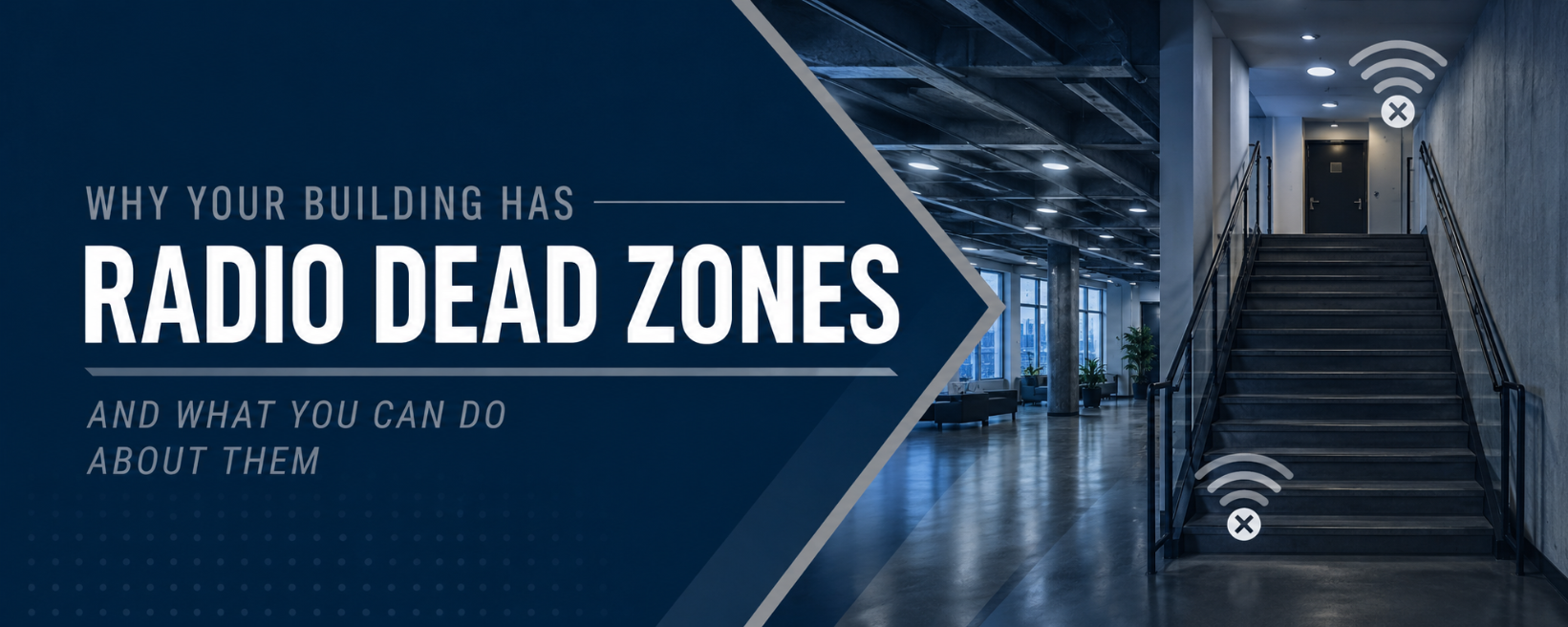
The radios work fine in the office. Then somebody walks into a stairwell, basement, production area or back corner of the building and suddenly nobody can understand them.
Sometimes the transmission gets broken up. Sometimes the employee can hear everyone else but cannot get a response back. In other areas, the radio may stop working altogether.
Those problem areas are commonly called radio dead zones, and we see them in all kinds of buildings. Warehouses, schools, hospitals, manufacturing facilities, government buildings and other large properties can all have areas where radio coverage becomes unreliable.
The first question usually is not which new radio to buy. It is figuring out why communication stops working in that particular area.
A Dead Zone Does Not Always Mean Complete Radio Failure
Some dead zones are obvious. You walk into an area, key the radio and cannot reach anyone.
Others are easier to live with, which can make them harder to recognize as a real coverage problem.
Employees may notice that:
- A transmission becomes broken or difficult to understand in the same part of the building.
- They can hear dispatch or another radio user but cannot reliably transmit back.
- The radio works near a doorway or exterior wall but struggles farther inside.
- Coverage is fine upstairs but becomes unreliable in the basement.
- One stairwell works while another one does not.
- Communication changes after machinery, inventory or equipment is moved.
Then there are the workarounds.
Someone walks back toward the doorway before calling. Another employee knows which corner of the room has better reception. People start repeating transmissions two or three times. Eventually, employees may pull out their phones because it is easier.
If that starts becoming normal, it is worth finding out what is happening.
Why Does Radio Coverage Change Inside a Building?
Buildings are hard environments for radio signals.
A radio signal that travels well across an open property may behave very differently after it has to pass through concrete walls, steel, multiple floors, equipment and everything else inside a large facility.
Start with the building itself
Concrete, reinforced walls, metal siding, energy-efficient glass and other building materials can reduce the amount of signal that reaches an interior space.
Then consider where the employee is standing.
A basement or below-grade parking area may have several layers of material between the radio and the outside system. Stairwells, elevators, mechanical rooms and interior corridors can create their own challenges.
This is why coverage can be perfectly usable in most of a building and still fall apart in one relatively small area.
The building may have changed
This one is easy to overlook.
Maybe the radio system worked well when it was originally installed. Since then, the company added a warehouse, remodeled part of the facility or installed another production line.
Even changes that seem unrelated to the radio system can affect coverage. Tall metal storage racks, new walls, machinery and high-density inventory can change how signals move through a space.
If coverage changed after a renovation, expansion, equipment installation or another change inside the facility, we want to know about it.
Sometimes it really is the radio
Not every weak transmission is a building coverage problem.
If one radio performs poorly everywhere while the rest of the fleet works normally, we would want to look at that individual unit. A damaged antenna, weak battery, programming issue, worn accessory or hardware problem could be involved.
Background noise can cause confusion too. If employees hear the radio clearly in a quiet area but struggle next to machinery, the RF signal may be fine. The issue could be speaker volume, an accessory or simply the amount of noise around the user.
Does the Problem Follow the Radio or the Location?
This is one of the simplest questions you can ask when trying to narrow down a coverage problem.
| What You Are Seeing | Where We Would Start Looking |
|---|---|
| One radio has problems in several parts of the building. | Check the radio, antenna, battery, accessories and programming. |
| Several radios struggle in the same room. | Look more closely at coverage in that location. |
| Employees can hear calls but have trouble transmitting back. | Check whether the portable radio’s return signal is reliably reaching the system. |
| The problem started after a building expansion. | Look at the new distance, layout and materials between the users and the radio system. |
| Communication is only difficult around loud machinery. | Check audio, accessories and the work environment before assuming it is an RF problem. |
This will not diagnose the entire system, but it gives us somewhere to start.
If five radios all stop working in the same stairwell, replacing those five radios would be an expensive way to discover that the stairwell was the problem.
So What Can Be Done About a Radio Dead Zone?
That depends on what is causing it.
Sometimes the answer is surprisingly small. Other times the building needs additional radio infrastructure.
If the problem follows one radio
Start with that radio.
The fix could involve an antenna, battery, programming change, accessory or repair. If the equipment is old or no longer suited to the work environment, replacement may make more sense.
If the system is almost reaching the area
Antenna or repeater placement may be worth reviewing. Changes to the location, height or configuration of system components can affect where the signal goes.
We would want measurements before making those changes. Moving an antenna because another location “looks better” is not much of a coverage plan.
If distance or obstructions are the problem
A repeater may be part of the answer.
A repeater receives a radio transmission and retransmits it, helping extend usable communication across a larger area. Whether one is needed depends on the property, frequencies, existing system and where communication is failing.
Some buildings need in-building coverage infrastructure
Larger or more difficult facilities may require a distributed antenna system, commonly called a DAS, to distribute radio signals through antennas placed throughout the building.
A bi-directional amplifier, or BDA, may also be part of an in-building system. The BDA supports communication in both directions between users inside the facility and the radio system outside.
That does not mean every basement with weak coverage needs a BDA.
These systems have to be designed around the frequencies and application they are supporting. Poorly planned amplification can create interference and other problems. Public-safety in-building systems may also have requirements established by applicable codes and the local authority having jurisdiction.
And sometimes the facility has simply outgrown the system
If a radio system was designed for a much smaller operation, there may come a point where another small adjustment is not going to solve everything.
A company may have added another building, expanded the property or put employees in areas that were never part of the original coverage requirement.
At that point, it may make more sense to look at the radio system as a whole.
How J&K Approaches a Building Coverage Problem
If several radios quit working in the same stairwell, we do not want to start by selling you new radios.
First, we need to understand what is actually happening there.
Where does communication work? Where does it stop working? Can the user hear but not transmit? Did the problem always exist, or did something change? Does every radio have the same problem?
We also need to know what system is already in place. That includes the radios, frequencies, programming, antennas, repeaters and any other infrastructure being used.
From there, coverage testing can help show what the signal is doing throughout the facility.
- Which areas of the building are giving employees trouble
- Whether every radio has the same problem
- Whether users can hear but cannot transmit back
- Whether the building has recently been expanded or remodeled
- Whether new machinery, storage racks or equipment have been added
- Which radio system and equipment you currently use
You do not need to diagnose the problem yourself. Those details just give us a better place to start.
Do Not Let Workarounds Become the Normal Way to Use the Radio
Radio dead zones have a way of becoming part of the routine.
People figure out where they need to stand. They know which doorway to walk toward. They repeat calls or ask another employee to relay the message. Eventually, nobody thinks much about it anymore.
That is fine right up until the message cannot wait.
If employees depend on two-way radios to coordinate work, security or emergency response, they should be able to use them in the places where the job actually takes them.
Frequently Asked Questions About Radio Dead Zones
What causes radio dead zones inside buildings?
Concrete, steel, multiple floors, basements, metal storage racks, machinery and the overall building layout can all affect indoor radio coverage. The radio system itself can also contribute if antennas, repeaters or other components are not providing enough coverage for the facility.
Why can I hear other radios but they cannot hear me?
The signal coming from the radio system may be strong enough to reach your portable while the portable’s lower-powered return signal has trouble reaching the system. Testing can help determine where that return path is failing.
Will buying more powerful radios fix a dead zone?
Not necessarily. If several radios fail in the same location, the issue may be related to the building or system rather than the individual handhelds. It is better to identify the cause before replacing equipment.
Can a repeater fix radio dead zones?
A repeater can help extend radio coverage, but it is not automatically the right solution for every building. The existing system, frequencies, property and locations of the dead zones should be evaluated first.
What is a BDA system?
A bi-directional amplifier can be used as part of an in-building radio coverage system to support communication between users inside a facility and an outside radio system. BDA and DAS systems need to be properly designed for the frequencies and application they support.
Having Trouble With Radio Coverage in Your Building?
Tell J&K where your radios work, where they do not and what equipment you are using now.
Our team can help determine whether the problem is coming from the radios, the building or the system behind them and what the next step should be.
Talk With J&K Communications